Last Updated: November 5, 2026
A failed French drain can look exactly like a drain placed in the wrong spot. The useful distinction is whether it once gave relief under comparable conditions. An old photograph of the outlet or a record of a new roof connection may be more informative than the wet grass above the trench.
Runwell Durham Drainage Company can help assess the exterior drainage work. To narrow the enquiry, first distinguish a formerly effective collection trench from an installation that never relieved the wet area. The distinction affects the work worth pricing and what you should look for on the finished property.
Work from the accessible end backward
Locate the discharge and look at the receiving ground during safe conditions. A buried outlet can mimic a failed trench; a clear end does not prove the collector remains permeable. Next consider any transition to solid pipe and the stretches under a drive or gate. Finally ask whether water still crosses the collection trench at the depth it was designed to intercept. This order helps avoid opening the most disruptive section first without a specific reason.
What would change the recommendation?
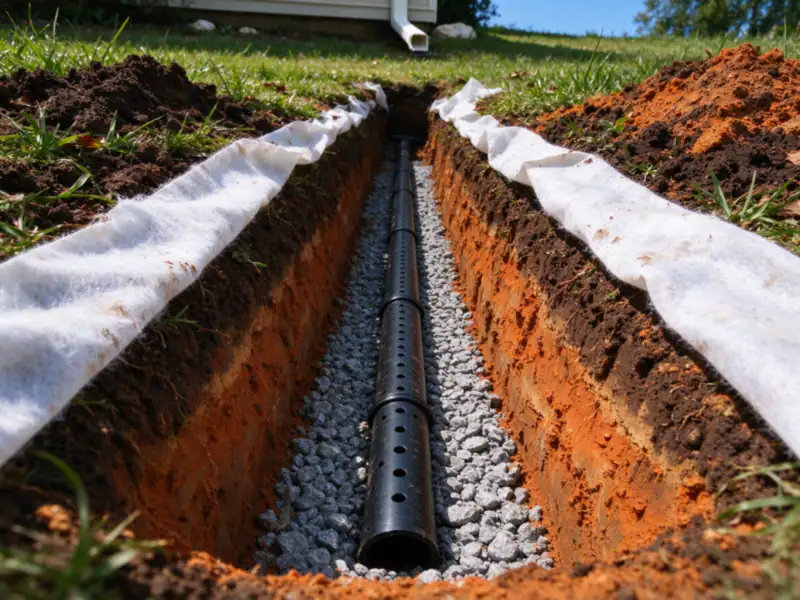
Take two possible observations. In the first, you find a clear perforated pipe surrounded by aggregate filled with fine soil. In the second, you find a working collector connected to a solid pipe with a crushed crossing. The visible wet area may look similar, but the two findings place the question at different points in the route. Record what you see directly and leave the underground part of the sketch open if you cannot identify it.
| Decision | First approach | Alternative to investigate |
|---|---|---|
| What are we addressing? | A formerly effective collection trench | An installation that never relieved the wet area |
| What could the scope involve? | Restore an accessible obstruction or damaged transition | Reassess trench position, filter assembly and discharge levels |
| What would help settle it? | Photograph the initial entry point and the surface immediately beyond it. | Identify remaining unknowns at the receiving end before committing to construction. |
A recurring obstruction deserves a second question
If a line has been cleaned repeatedly, find out what was removed. Leaves suggest an entry point or connected roof source. Fine soil can point to damaged joints or a collection assembly that allows migration. Sediment arriving from the same unprotected slope may need source control. The useful repair depends on where the material got in; a clear pipe immediately after cleaning is only one part of the evidence.
Follow the decision onto a real layout
For example, consider a previously reliable inlet that now overflows. The owner wants to restore the original useful drainage function. Establishing the condition of the retained route downstream of the defect can change whether a proposal is practical even after the likely cause has been narrowed down. On the drawing, include a finished patio over part of the retained line as well as the area that gets wet. That feature can determine where equipment goes and what must be protected.
A proposal addressing only the most visible symptom deserves a closer question. What happens farther along the route, and where can someone inspect the result later? If the outlet stays submerged even when the inlet is clean, the observation should be weighed against the original assumption. Compare the timing with the condition in the photograph. A route that works when the receiving ground is dry may perform differently when the same storm has wetted the entire property.
Locate the failure before pricing the excavation
Start with the accessible inlet and outlet. When did the system last perform as expected, and under what conditions? A single intense event gives less information than a change noticed after a fence post, utility trench or paving job. A contractor may be able to narrow the affected section before opening the lawn, but buried joints and unknown branches can limit certainty. Agree what investigation buys and which findings would change the repair price.
A record of the retained pipe
Photograph the exposed connection from far enough away to include a fixed feature. A close-up can confirm the joint detail, but it will be hard to locate later without the wide view. Keep the photographs and a note of what remained buried with the property records.
How a repair decision changes at the transition
Picture an intercepting trench that once kept a garden path usable. A solid outlet pipe passes under a gate beyond the collector. If that crossing has been crushed, opening the entire gravel trench would disturb sound collection work while missing a small downstream defect. If the crossing is sound but fine soil has filled the aggregate, replacing the downstream pipe would have the opposite problem.
Ask which observation points to one location rather than the other. In particular, distinguish evidence that water enters the collector from evidence that the outlet actually discharges. A contractor may recommend a focused opening at a transition to answer that question. Agree beforehand what will be restored if the opening reveals sound pipe and what additional work would require your authorization. This makes investigation a defined purchase instead of an open-ended commitment to rebuild the whole system.
Compare the work you would authorize
For the first proposal, write down how it deals with a formerly effective collection trench. For the other, ask what finding supports treating an installation that never relieved the wet area as the deciding issue. One proposal may include restoration and a maintained outlet; another may stop at a buried connection whose destination is unknown. Those are materially different purchases even when the visible starting point is identical.
Before selecting a contractor scope, ask for the observations behind the recommendation and the conditions that could change it. Describe the access route, the surface that must be reinstated and any later landscape work. If another party controls the receiving feature, establish who can approve a change before committing to the part on your land. This keeps a useful private improvement distinct from a connection that may need a different route.
Questions about this decision
Does flushing a French drain clean its surrounding stone?
It may clear some obstructions in an accessible sound pipe. It does not reliably restore voids in a soil-filled aggregate envelope. Ask which part of the system the proposed cleaning reaches.
Could recent landscaping cause a French drain backup?
A raised finish can bury an outlet, compact soil or change incoming flow. Compare the old route record with the current surface before assuming the entire trench failed.
What observation would help distinguish a formerly effective collection trench from an installation that never relieved the wet area?
Bring a wide view of the incoming water and one of the receiving area. Note the date relative to rainfall, irrigation or recent work. In particular, mention a clear perforated pipe surrounded by aggregate filled with fine soil if it matches your property. That detail gives the conversation a specific route to examine.
Your next step
If a working collector connected to a solid pipe with a crushed crossing describes your situation, start with that detail. Include what you want back from the affected part of the property, such as a usable walkway or ground that can be maintained. Read Outdoor Drainage Repair in Durham, NC for the related work, or contact Runwell to discuss which checks belong in your estimate.