
Last Updated: November 5, 2026
In Cary, “take the pipe to the curb” leaves a question unresolved. Is the proposed outlet on private ground, or will construction occupy town right-of-way? The town provides a minor encroachment process for applicable French drain work in its right-of-way, including outlet details. Resolve that choice before buying the shortest route.
Runwell Durham Drainage Company handles private exterior drainage enquiries for Cary properties. Include the address and the part of the property you want to use again so we can discuss availability, jurisdiction and an appropriate scope.
Compare two discharge drawings
Ask for one drawing showing any workable private receiving area and another showing the proposed curb-side arrangement. Include the collection level, walkway, pavement edge and ground beyond the outlet. A private route can require more trench but avoid hardscape disturbance. A curb route can involve permission and reinstatement as well as pipe. Neither is automatically preferable. The comparison only makes sense when both drawings show what happens during rain at the far end.
Water on a walking surface changes the result
A homeowner may want to keep a side bed from flooding without making the pavement below it slippery. Check where concentrated water travels after discharge and what happens when the receiving ground is already wet. Distinguish town-maintained infrastructure from privately maintained drainage. If the problem concerns a public feature, describe that observation to the town; keep any private collection work on a separate line of the estimate.
Put the curb detail beside the private alternative
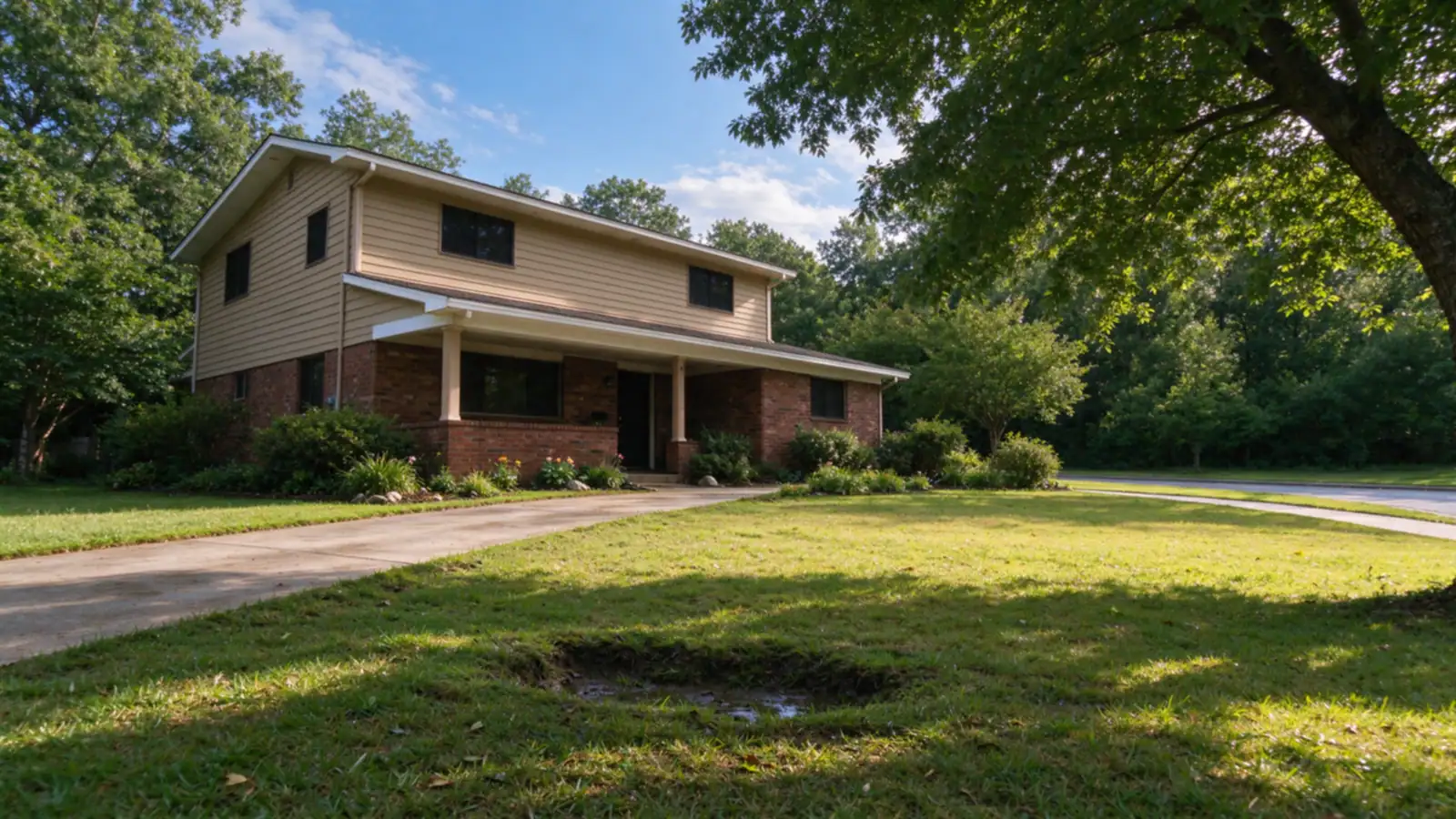
Imagine a rear collector running down a Cary side yard toward the street. The owner wants to keep water out of the bed beside the house, not necessarily to build a connection at the road. One drawing ends in a stable private receiving area. Another continues past the walk into town right-of-way. Compare what happens beyond each outlet. If the private end would sit in a waterlogged pocket, its shorter permission process does not make it effective.
If the curb route requires review and pavement restoration, its convenient fall does not make it automatically cheaper. Show both the private benefit and the downstream dependency before committing to either route.
Trace the high-water condition
A lid that opens in a dry demonstration may sit below the water level of the receiving ground during a storm. That condition reduces the difference in level available to move water through the route. At the other extreme, a free outlet on a steep slope can release enough concentrated flow to scour the ground. Compare both the ability to discharge and what the water does next. They are separate design questions.
Control where a change order can begin
If approval for a proposed encroachment is still pending, ask what the contractor can price firmly and what remains conditional. A revised termination can change the trench depth several yards upstream. It can also move the crossing through a planted bed or require a different restoration detail. Agree on an authorization point before excavation that depends on the unresolved endpoint. For a suspected problem in town-maintained infrastructure, keep the observation and location ready for the town.
For a private issue, include the source, accessible route and the receiving condition you can see on your own property. Those enquiries can proceed without assuming one party owns both problems.
Do the receiving-ground test on paper
Draw a circle where the outlet ends and then draw the next ten or twenty feet of surface flow as far as it is known. Will water spread over stable ground, concentrate in a small bed or cross a pedestrian route? Where information is missing, mark the question instead of drawing a convenient arrow across a boundary. This is an especially useful way to compare a longer private route with a short route that needs a third party’s consent.
Think beyond the last machine pass
Freshly shaped soil may look smooth before the finish goes on. Sod adds thickness. Mulch can form a ridge. A strip of edging can cut directly across an intended escape path. The relevant surface is the one that remains after those materials are installed. Agree on the finished relationship between the lawn, the bed and the walk. A simple photograph along the intended route after restoration gives the owner a useful reference for later topdressing.
Property records and next steps
Consult the Town of Cary’s drainage questions and its stormwater guidance for residents. If the proposed outlet or disturbance area changes, confirm that the response still applies.
What belongs beside the curb option on a written quote
Ask the contractor to identify the last point within private ground and the first element dependent on town review. Include the surface that needs reinstatement at that boundary. If a walk or curb-side landscape strip must be disturbed, compare the complete restoration with the disruption of a longer lawn route. Check whether the price assumes a particular approved outlet detail. If approval changes that detail, ask which costs could move and what work would need a separate authorization.
For a private alternative ending in a lawn, evaluate the ground beyond the termination rather than assuming fewer permits make it the better purchase. If that area is already saturated, a protected outlet or different routing may be needed. Discussing the alternatives this way lets a Cary owner choose how much uncertainty to resolve before accepting a price. It also provides a useful record when another project later changes the front walk or the receiving landscape.
Photograph the proposed discharge area before new planting makes its original level difficult to recognize.
Questions about this decision
Does a Cary curb provide an outlet for any private French drain?
The curb’s presence does not authorize construction or discharge. Check the route and outlet with the applicable authority and document the approval required for that particular work.
Why compare a longer private route in Cary?
Access and restoration at a curb crossing can change the scope. A longer lawn route may preserve a paved edge if the private receiving area is demonstrably suitable.
How should a Cary estimate treat an unapproved curb outlet?
Call it a conditional route and identify the approval, outlet detail and reinstatement assumptions. Ask what would be repriced if the authority requires a different termination.
Does a short Cary front yard rule out a private outlet?
Only site assessment can settle that. Compare actual levels, receiving conditions, walking surfaces and the route beyond the outlet. Limited length and limited absorption are separate constraints.
What can a Cary homeowner record at the street safely?
Observe from a safe private location whether runoff reaches the sidewalk or remains in the lawn. Identify the street and feature for the town without entering traffic or lifting a public cover.
Discuss Cary drainage work
For a proposed French drain beside a walk leading to the curb, compare French Drain Installation in Durham, NC with Channel Drain Installation in Durham, NC. Discuss the property with Runwell and mention any decision still needed from Cary’s right-of-way review staff for the proposed encroachment.